- Mar 10, 2026
- --
Navigating the China firewall
Technical strategies for mastering the digital experience management
-
 Nora NowackSenior Product Marketing Manager, Magnolia


Experience Magnolia in action
Experience Magnolia's key features firsthand in an interactive product tour.
Take a tour nowKey insights
Architectural isolation: Operating in China requires a dedicated cluster and infrastructure to ensure stability and compliance with local regulations.
Regional build configuration: Developers must utilize the dedicated China Maven repository and specific build flags to ensure reliable deployment behind the firewall.
Local infrastructure: Transitioning to Alibaba Cloud (Aliyun) is essential for performance, leveraging 2,800+ local nodes that global CDNs cannot reliably access.
Strategic identity management: Utilizing Authing enables brands to bridge the gap between global Google-based authentication and local requirements like WeChat login.
As a leading Digital Experience Platform (DXP) for global brands, Magnolia DXP has spent years navigating the complexities of the Chinese digital landscape. This post is born from that experience—specifically from our work supporting enterprise leaders in the manufacturing and service sectors as they expand their reach into mainland China.
Expanding a digital presence into China requires more than just localizing content; it demands a fundamental shift in architectural strategy. Due to the unique regulatory environment and technical constraints—often referred to as the "Chinese Firewall"—organizations must treat their China operations as an isolated "island" rather than a simple extension of global infrastructure. By architecting high-performance solutions that function seamlessly within this ecosystem, we enable you to scale your digital presence without the burden of technical debt.
The reality of the "Chinese island" architecture
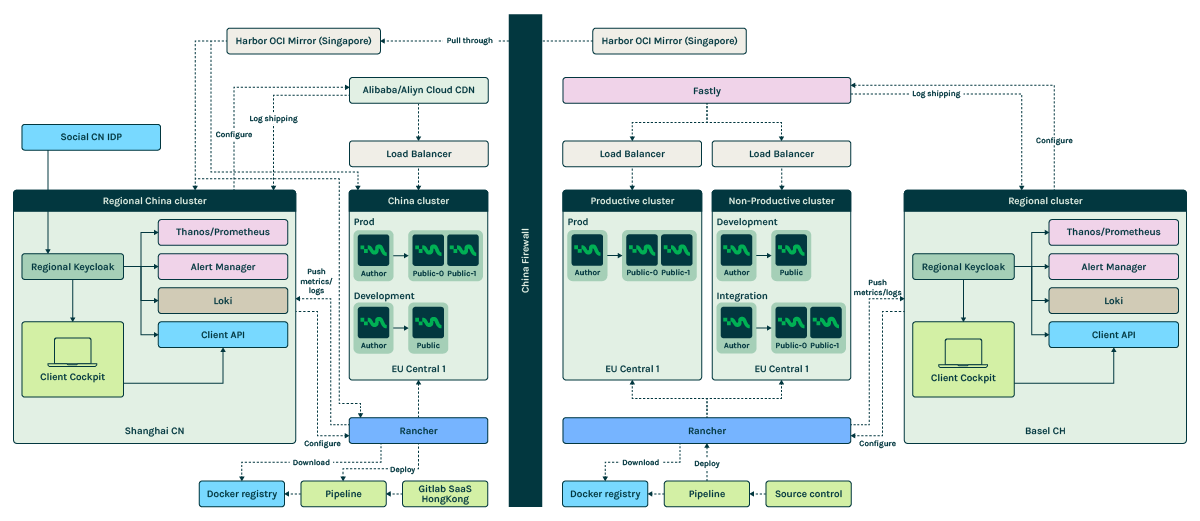
To maintain a stable digital presence in mainland China, organizations must bridge the gap between global standards and local technical realities. The "Chinese Firewall" causes unpredictable connection drops and timeouts for Western-hosted services, making a direct global-to-local publication model unreliable.
To solve this, Magnolia DXP enables organizations to deploy a dedicated China cluster. This cluster acts as an independent entity—a technical island—that mirrors the look and feel of the global architecture while functioning under local rules and regulations.
Essential regulatory and technical prerequisites
Before deploying any infrastructure, organizations must navigate specific hurdles:
The ICP license: Operating a domain in China requires an official Internet Content Provider license. This process typically takes one to three months and requires a local corporate identity.
Local cloud hosting: While Magnolia DXP previously utilized Tencent, the strategy has shifted to Alibaba Cloud (Aliyun) for its superior automation stack and deep integration with the mainland’s digital ecosystem.
Technical reality: regional repositories and cloud infrastructure
A core challenge for development teams is that standard Western container and code repositories are often throttled or blocked. Magnolia DXP has optimized the developer experience for the region by providing dedicated local resources and specialized deployment workflows.
Regional developer resources
Magnolia DXP now offers a new, dedicated option to serve the China region: a regional Nexus repository. This allows developers to serve Magnolia DXP packages and execute builds in close proximity to the mainland, significantly increasing reliability and speed.
Regional Repository: http://nexus.ap.magnolia-cms.com
Build Command: Developers should use a specific flag to ensure the build pulls assets from the localized repository rather than the western endpoint.
Overcoming content and container image blocks
Because content for China is strictly separated, a direct sync from a “western” Magnolia DXP instance is not possible; while exporting and importing specific content or assets is achievable, this requires a case-by-case evaluation. Magnolia DXP can support hosting critical container images into China mainland via a “Cascading Pull Through Mirror” solution.
Optimizing performance and identity behind the firewall
To provide a high-performance experience, the front-end architecture must be as localized as the back-end.
Alibaba Cloud CDN: With over 2,800 nodes in mainland China, this CDN provides the low-latency delivery required for enterprise-grade stability. It offers specialized scheduling that western CDNs (like Fastly or AWS) cannot guarantee within the firewall.
Gitlab SaaS in Hong Kong: To manage code pushes effectively, Magnolia DXP utilizes a local Gitlab hosting solution in Hong Kong.
Content orchestration and the "pull" model
Magnolia DXP partners have recognized that a global "Offer" team cannot effectively publish directly to China. Instead, Magnolia DXP supports a "pull" model where local teams manage market-specific content. To ensure these experiences load reliably for local users, all assets—including Digital Asset Management (DAM) content—must be replicated within the region.
Digital Asset Management (DAM) Integrations
Integrate an external DAM with just a few lines of configuration and make assets available directly within Magnolia DXP.
Get the Product BriefFor this specialized storage, Alibaba Cloud (Aliyun) Object Storage Service (OSS) provides the necessary infrastructure. Comparable to Amazon S3 or Azure Blob Storage, OSS allows you to store and serve assets directly from within China, eliminating the latency and reliability issues associated with fetching media from Western buckets.
Authentication with Authing
Since Google and Facebook are blocked, Magnolia DXP integrates with Authing, a local Identity-as-a-Service (IDaaS) provider. This allows organizations to maintain global standards (like Google-based authentication) for internal teams where permitted, while facilitating local social logins such as WeChat for end-users.
Why a strategic approach to China matters
Entering the Chinese market is typically a second or third phase in a brand's global expansion. It requires significant strategic alignment, budget, and a commitment to building a local team.
Magnolia DXP enables organizations to reuse their existing code, templates, and Corporate Identity within the China cluster. By accounting for China-specific parameters and regional repositories, enterprises can scale their digital operations with Magnolia DXP's experience launching in the Chinese Mainland market.