- Oct 2, 2026
- --
How to scale global content with agentic AI
-
 Jan SchulteHead of Group Consulting, Magnolia

Experience Magnolia in action
Experience Magnolia's key features firsthand in an interactive product tour.
Take a tour nowKey insights
-
Capacity is the bottleneck, not ideas. AI agents shorten the path from brief to first draft, and data from site search and AI visibility tools shows what to write first.
-
Put your brand guidelines into the translation process. Market profiles with tone of voice and approved terms give local teams a draft that's most of the way there, so they can spend their time on nuance.
-
Getting found now includes AI search. Answer the questions each market is asking, structure pages with FAQs and generate JSON-LD structured data for every locale.
-
Start with housecleaning. Outdated or conflicting content derails AI output: garbage in, garbage out.
Scaling global content is now a workflow problem
Content demand is growing faster than content teams. Every new market adds languages, channels and review loops. Now your content also has to be found and cited by AI search tools such as ChatGPT, Perplexity and Google's AI Overviews.
Scaling global content with agentic AI means handing the repetitive, multi-step production work to AI agents: drafting, assembling pages, translating against your brand rules and generating metadata. Your people keep the strategy, the cultural judgment and the final sign-off. You get speed and control in one workflow, not a trade-off between the two.
That was the focus of episode one of our AI mini-series, AI for Digital Experience: Scaling global content with agentic AI. Ellis Devine, who looks after partner marketing at Magnolia DXP, moderated the session. The guests were Nicole Rogers, co-founder of Magnolia DXP partner ai12z, which specializes in AI search, digital assistants and AI visibility, and Jan Schulte, Head of Group Consulting, who has 13 years at Magnolia DXP. Here's what we learned, and how you can apply it.
https://www.magnolia-cms.com/library/webinars/ai-for-digital-experiences-webinar-series-emea.html
Watch episode one on demand
See Jan Schulte's live demo and the full conversation with ai12z on scaling global content with agentic AI.
Watch on demandWhy capacity, not ideas, holds content teams back
The opening poll set the tone.
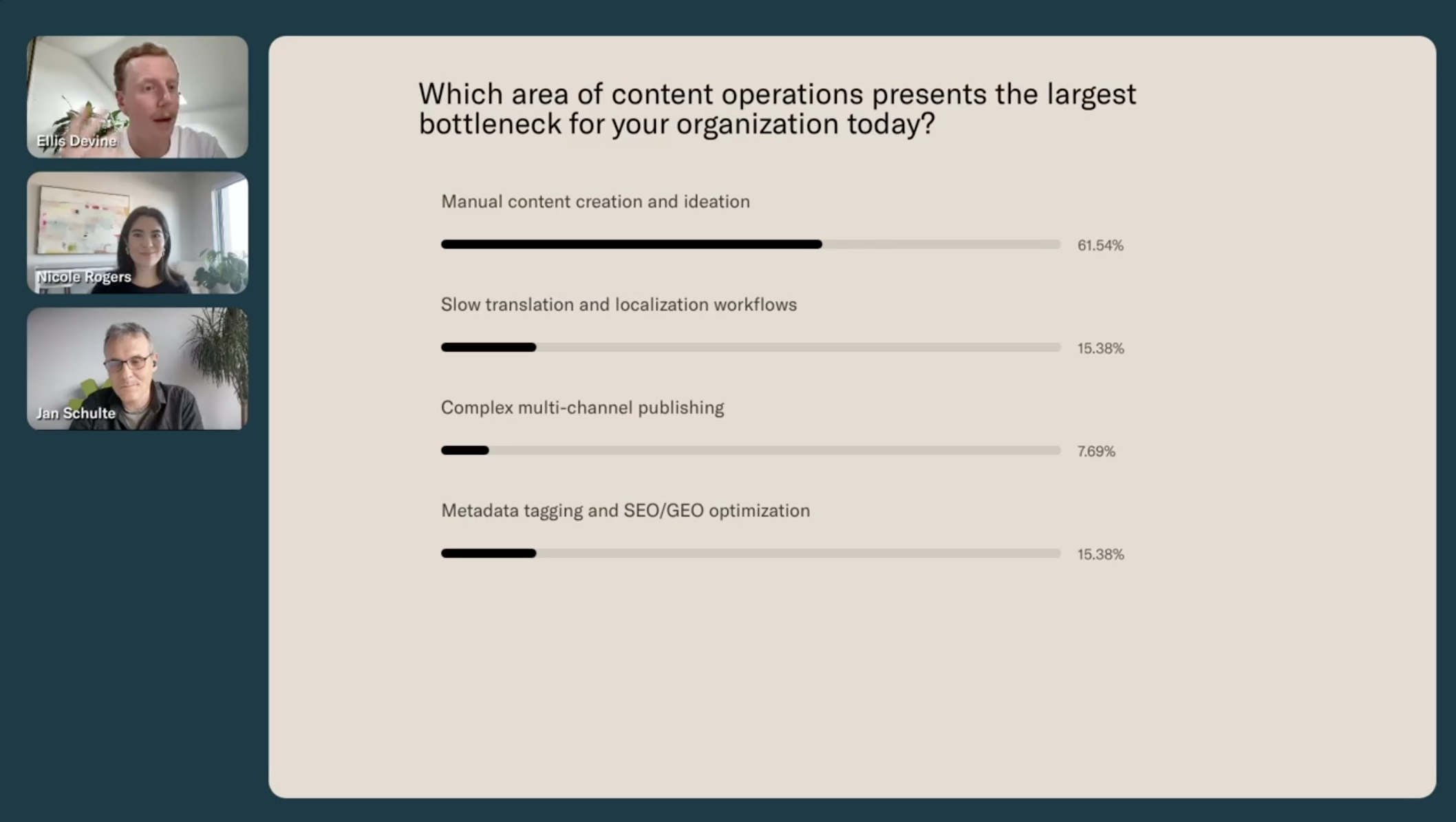
Attendees named manual content creation and ideation, complex multichannel publishing, and metadata tagging for Search Engine Optimization (SEO) and Generative Engine Optimization (GEO) as their biggest bottlenecks. Ellis summed up the pressure: "there's more content across more channels, across more markets, and it's growing faster than teams can manage."
"There's more content across more channels, across more markets, and it's growing faster than teams can manage."


Nicole sees two places where AI agents win back the most time.
Deciding what to create. "Teams have a lot of ideas out there… but they really are lacking the evidence behind what to prioritize," Nicole said. A search bar or digital assistant on your website shows the questions visitors actually ask. AI visibility reports show which of those questions your content already answers. "So this will actually guide your content strategy."
Getting from idea to first draft. Most teams already have the expertise, the PDFs, the spreadsheets and the survey results. The hard part, as Nicole put it, is this: "how do you turn all of those materials into an actual first usable draft?" Agents can turn that raw material into a structured draft for your team to shape.
Jan has watched the tooling change fast. "A year ago, it feels like an eternity ago," he said. A year ago, AI in content management meant point-to-point actions, such as auto-classifying an image or filling in a metadata field. Today, agents chain those steps together. "I think it's really the biggest shift that I've seen in my full career if it comes to content management," Jan said. "It really shifts from doing all those things manually to just basically prompt what you need." Ask for personalized variants, a full page from a draft, or GEO-ready metadata, and the agent works through the steps for you to review.
What are organizations asking AI to solve? Nicole hears two answers. Content teams want to speed up production. Website visitors want direct answers, with the same conversational experience they get in ChatGPT or Perplexity. Either way, "organizations really want to use AI to help them achieve those business outcomes sooner."
Quote
Organizations really want to use AI to help them achieve those business outcomes sooner.
"Organizations really want to use AI to help them achieve those business outcomes sooner."


When a digital assistant connects to systems such as a Customer Relationship Management (CRM) or Enterprise Resource Planning (ERP) platform, it can also help visitors complete steps like a booking or a registration. That calls for clear human oversight. It also means you tell visitors they're talking to an AI assistant, which is a disclosure duty under the EU AI Act.
Inside an agentic content workflow
What does this look like in a real Digital Experience Platform (DXP)? Jan showed it live in Magnolia DXP, using the agents in Magnolia Renivo (formerly AI Accelerator).
From brief to page, with the components you choose
The classic workflow hasn't changed much since content management systems began. A copywriter delivers a Google Doc or Word file, and someone rebuilds it on the page one component at a time. Agents now take over much of that rebuild. Jan described two routes:
Doc-to-Page for structured control. "We have a dedicated feature, Doc-to-Page. So you can then basically predetermine what kind of components you absolutely want to see. Especially great for regulated environments." Read more in Doc-to-Page: From brief to on-brand page in minutes.
Agent-led assembly for flexibility. Using Magnolia's agentic AI authoring tools, the agent reads the copy and picks the components itself.
In the demo, Jan pasted in the copy for a webinar page and asked for a full page. The agent read the instructions, chose the components, and handed the build to sub-agents that created the hero, text and supporting components. Then it offered to add images. Because the images in the asset library were already tagged, Jan simply asked it to select a matching image and apply it. The result was a complete draft page, ready for an editor to review before anything goes live. Renivo never publishes without human review.
Renivo is an integration layer. It connects to third-party AI models from providers such as OpenAI, Anthropic and AWS Bedrock through the AI Connector framework, and it keeps an audit trail of what changed, when, which model was invoked and by which user. The agents are also extensible. As Jan explained in the Q&A, you can register your own tools, so teams can add new capabilities without waiting for a roadmap. You can see Magnolia agentic AI in action in our click-through product tour, or read how the architecture works in Inside the Magnolia agents.
https://www.magnolia-cms.com/library/product-tours/magnolia-ai-showcase.html
See Magnolia agentic AI in action
Learn how to accelerate your enterprise teams by using Magnolia agentic AI to create engaging and structured content and safely automate your DXP strategy.
Start the tourTranslation with your brand built in
Machine translation has come a long way. Jan traced the path from early Google Translate and Microsoft Translator output, which you could just about follow, to DeepL, which was a big step toward production quality. DeepL still needs long custom dictionaries to get specialist terms right in each market.
The next step is market profiles. Each profile describes the tone of voice and context for a target market, and it's applied during translation itself. "That's basically the next evolution step, that you really have your brand guidelines as part of the translation process," Jan said. For the broader strategy behind this, see Localization vs. translation: Building a global content strategy.
Grounding agents in your own content
Hallucinations are a common concern. Nicole's advice is to ground the agent in material you control, such as your website content and approved internal documents: "you want it to use your own content versus the LLM's knowledge." Grounding is designed to keep the large language model (LLM) close to your approved sources, not its general training data. A system prompt adds rules on top, such as using only your content and following your brand guidance.
The same approach lets you keep content live on your website while leaving it out of what the AI draws on. Asked how to do this in the Q&A, Nicole explained that you can set parameters in the system prompt, for example, telling the agent not to use blog posts older than a certain date. You can also add fresh sources, such as user guides, manuals or your support team's FAQs.
Making every locale readable for AI search
Much of classic SEO still applies in AI search. Jan's point is that "the structure becomes more important." FAQ sections are one visible sign of this: when a question matches, an AI tool has a good chance of picking up the answer. The other sign is JavaScript Object Notation for Linked Data (JSON-LD), a set of machine-readable metadata that AI agents use to index your pages. "That's not something that you write by hand," Jan said. In Magnolia DXP, the GEO optimization feature generates JSON-LD from the page content for each locale configured on your site.
Consistent across markets, visible in AI search
One brand, many markets
Nicole has seen what regional silos do to a brand. At a previous company, she recalled, "We had the North America team, the EMEA team, the APAC team, as many organizations do. And they all use different agencies." The local expertise was valuable. "But then the brand started looking different across the regions."
Speed suffers as well as consistency. In the agency model, Nicole explained, "that process can take weeks. And then by that time, by the time you actually go live with the content, the original messaging has changed." Give an AI-supported workflow your brand guidance, terminology, approved messaging and look and feel, and it starts each market from the same base. Local experts then review "something that is already halfway there or 70% there. And then they can add in the cultural nuances." You get global consistency and local relevance, with humans making the final call.
This matters most for European organizations that run many languages from one platform, such as multi-country brands in the DACH region, Switzerland and the Nordics. For them, governance and data handling come first. Customer content isn't shared with model providers for training. That supports GDPR and EU data residency. Magnolia DXP is ISO 27001:2022 and ENS (High) certified and SOC 2 Type II attested, with GDPR and DORA readiness. Our EU AI Act statement sets out how we support your transparency obligations.
Getting found in AI search, market by market
Once content is live and localized, people still need to find it, and more of them now search through AI. Nicole says "getting found really starts with understanding the questions that your audiences are asking in each market." Answer those questions clearly and consistently, back them with credible sources, then monitor AI search tools to see where your brand is mentioned, cited or recommended, where competitors appear, and whether your brand is represented accurately.
"Getting found really starts with understanding the questions that your audiences are asking in each market."
The value lies in turning that monitoring into prioritized actions. Nicole's examples: a landing page for a vertical that audiences keep asking about, a new FAQ block, or a response to a pattern like this: "we keep getting compared, i.e., ChatGPT, to this competitor. So we should then create a comparison chart on us versus that." For a practical starting list, use our checklist on how to prepare your content for GEO, and read how SEO and GEO fit together in From SEO to GEO and back again.
Content teams move up the value chain
Does agentic AI replace content teams? Nicole was clear: "Agentic AI changes how content teams spend their time, but it doesn't replace the strategy that they bring, the creativity that they bring, the audience understanding, the cultural understanding."
"Agentic AI changes how content teams spend their time, but it doesn't replace the strategy that they bring, the creativity that they bring, the audience understanding, the cultural understanding."
The repetitive production work shifts to agents. Teams spend more time on strategy, quality and keeping content current for both human and AI readers. Jan goes further and argues that content teams become more relevant: "content is really the absolute key to be even considered nowadays."
"Content is really the absolute key to be even considered [by AI’s] nowadays."

Head of Group Consulting at Magnolia DXP
Both speakers named the same first step. Old pages that no one read used to be harmless. Now they're part of the corpus an AI draws on, and conflicting messages derail the answer. "Step number one is really, from my point of view, housecleaning," Jan said. "Just making sure that you only have content that is truthful, relevant, and not redundant."
"Step number one is really, from my point of view, really housecleaning. Just making sure that you only have content that is truthful, relevant, and not redundant"
Nicole agreed: "Garbage in, garbage out. Content is still king."
A quick way to see where you stand is our CMS audit. It's an eight-minute assessment of how AI-ready your CMS is, and it comes with a personalized 90-day plan.
Speed across markets, with governance built in
Scaling global content is no longer a question of hiring more writers or adding more agencies. It depends on an orchestrated workflow. Agents draft, assemble, translate against your brand rules and generate structured data. Your teams set the strategy, add local nuance and approve what goes live.
Magnolia DXP brings those pieces together. Doc-to-Page and agent-led page assembly get you from brief to page. Brand-aware translation and GEO optimization help your content work across markets and in AI search. Human review, audit trails and EU data residency give you the controls to govern it all. As Ellis put it at the close of the session, it very much feels like the start.
Stay tuned for future episodes of the Magnolia AI mini-series!
Interested in learning more about how to scale global content with agentic AI?
Register nowFor a deeper look at the practice, download our white paper on AI in practice.
How can content teams make the most of AI?
Learn how to produce better content faster with AI.
Download white paper





.png)